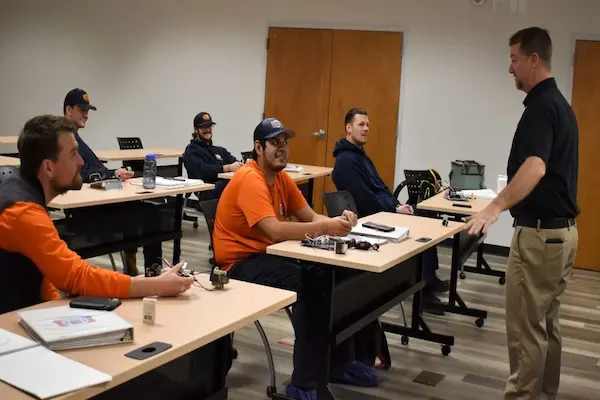
Firefighter paid training is now a real path — cities and the federal government hire you first, then train you.
You can earn a full salary while earning your certifications, with zero tuition and full benefits from day one.
Read on and discover which programs are hiring right now and how to apply before the next cycle closes.
See Also
- Government job programs: training, hiring, and benefits
- How to fund your education with grants and aid
- Continuing education: online courses and CEUs explained
- Step-by-step guide to applying for government benefits
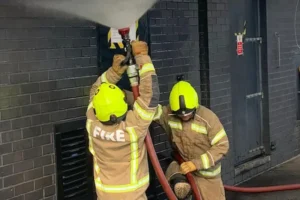
Firefighter Paid Training: The “Hired First, Trained Second” Model in 2026
The biggest shift in firefighter recruitment in 2026 is simple: you no longer need to pay for your own training before you get hired.
For years, the standard path required candidates to self-fund a fire academy — spending between $1,800 and $3,800 out of pocket — before even being considered for a department position.
That model still exists, but it is no longer the dominant one.
Today, the most competitive and accessible pathway is the Municipal Cadet Program, where a city or county department hires you at a full salary from day one and then puts you through their internal academy at zero cost to you.
The shift reflects a nationwide personnel shortage that has pushed fire departments — both municipal and federal — to compete aggressively for qualified candidates by removing the financial barrier to entry entirely.
If you’ve been waiting because you couldn’t afford a self-funded academy, 2026 is the year that obstacle is effectively gone for candidates who meet the physical and age requirements.
City Cadet Programs: Earn a Salary While You Train
Municipal cadet programs are the fastest and most financially accessible route into a firefighting career, and several major cities expanded their intake significantly in 2026.
In Austin, TX, starting cadet pay sits at approximately $22.55 per hour — around $46,904 annually — for the duration of the six-month academy. Upon graduation, the salary jumps to over $66,000 per year, making it one of the highest starting trajectories in the country for a paid fire training program.
In Washington, D.C., the Cadet Program specifically targets residents between the ages of 18 and 21, offering a salary of $37,336 plus full benefits while cadets earn both their EMT and Firefighter I & II certifications — credentials that, in a self-funded program, would cost thousands of dollars to obtain separately.
Houston, TX offers a “Firefighter Trainee” classification with a starting annual salary of $36,114 during training, with departments also offering additional incentive pay for candidates who arrive with an existing EMT-Basic certification.
These three cities represent a national pattern: departments are building earn-while-you-learn pipelines because waiting for pre-certified candidates has created staffing gaps they can no longer afford.
For candidates researching how structured government hiring programs work — from application steps to benefit enrollment — the guide on government job and training programs is a useful starting point before your first application.
Federal Wildland Firefighter Paid Training Programs
The federal government now offers some of the most comprehensive paid firefighter training pathways in the country, particularly for candidates interested in wildland and forestry careers.
The Wildland Firefighter Apprenticeship Program (WFAP) is the flagship: a 12-to-48-month program where you are hired as a permanent federal employee — through the U.S. Forest Service, Bureau of Land Management (BLM), or National Park Service — and receive 3,000 hours of paid work experience combined with structured classroom training.
Unlike a cadet program, this is not a temporary trainee position. You enter as a permanent federal employee from the start, with the pay, benefits, and job security that classification carries.
In early 2026, the Department of the Interior launched the U.S. Wildland Fire Service — a unified, standardized career pathway designed specifically to create clearer school-to-career pipelines, with particular focus on tribal youth and rural communities that have historically had limited access to firefighting careers.
Applications for 2026 federal wildland positions typically open in late summer — August and September — through USAJOBS.gov, which is the official federal hiring portal for all U.S. government positions.
If you’ve never navigated a federal application process before, understanding how to prepare documentation and meet formal requirements is critical — and the step-by-step guide on how to apply for structured government programs gives you a practical framework for doing exactly that.
IAFF Apprenticeships and State-Sponsored Fire Academies
Union-backed apprenticeships offer some of the most financially stable paid firefighter training available — and they come with long-term career protections that cadet programs typically don’t include.
The International Association of Fire Fighters (IAFF) partners with local fire departments across the country to run federally registered apprenticeship programs, which by law must follow a “progressively increasing wage scale” — meaning your pay is contractually guaranteed to rise at every training milestone you complete.
This structure makes IAFF apprenticeships particularly attractive for candidates prioritizing long-term financial stability over the highest possible starting salary, since the combination of living wages, union benefits, and automatic raises creates a predictable income trajectory from the beginning.
At the state level, programs like Washington State’s Fire Academy operate on a dual-track model: open enrollment for self-funded candidates, and agency-sponsored placement for recruits whose hiring department covers all costs and wages.
If you are applying through an agency-sponsored track at a state academy, your training cost is zero and your wages during training are covered entirely by the sponsoring department — functionally identical to a municipal cadet program, but at the state rather than city level.
Understanding how to access continuing education credits and CPD requirements that complement a firefighting career — especially for EMT or paramedic certifications — is something the guide on continuing education options for working professionals addresses in practical terms.
Paid vs. Self-Funded Firefighter Training: Which Path Is Right for You
The right choice depends on your geographic flexibility, your timeline, and your long-term career goal — not just which program pays the most upfront.
Here’s a clear comparison of the four main paths available in 2026:
- City Cadet Program — $0 cost, $35,000–$55,000 salary during training; best for candidates committed to working in a specific city long-term
- Wildland Federal Apprenticeship — $0 cost, hourly pay plus overtime and hazard pay; best for those drawn to forestry, outdoor, or rural emergency response careers
- IAFF Union Apprenticeship — $0 cost, living wage plus full benefits; best for candidates prioritizing long-term union protections and career stability
- Self-Funded College Academy — $1,800–$3,800 tuition, unpaid during training; best for candidates who want to pre-qualify and be more competitive across multiple departments simultaneously
The self-funded path still has strategic value — primarily for candidates who want to apply to multiple departments in different cities and arrive already certified, which can give them a competitive edge in highly selective programs.
For most candidates, however, the paid options in 2026 are superior in almost every measurable way: no financial risk, immediate income, structured training, and a guaranteed job at the end of the process.
Key Requirements Before Applying to Any Paid Firefighter Training Program
Meeting these requirements before you apply dramatically increases your chances of selection — especially in municipal cadet programs where competition remains high despite expanded intake.
The most impactful thing you can do is obtain your EMT-Basic certification before submitting any application.
Even in fully paid programs where the department will certify you during training, arriving with an existing EMT-B shows initiative and technical readiness — and in departments like Houston, it directly triggers additional incentive pay from your first day of employment.
The Candidate Physical Ability Test (CPAT) is a non-negotiable requirement for most paid programs, and it must be passed before your first day of paid training in the majority of municipal and federal pathways.
The CPAT involves eight consecutive job-related tasks — including stair climbing with weight, hose dragging, and ladder extension — performed within a 10 minute 20 second time limit. Preparation typically requires 8 to 12 weeks of structured physical training, and many departments offer CPAT preparation resources at no cost.
Age limits are also a factor worth checking early: most municipal cadet programs cap applicants at 35 to 37 years of age, while federal wildland positions generally offer more flexibility and in some cases have no strict upper age limit.
Finally, a clean background check, valid driver’s license, and in most cases a high school diploma or GED are baseline requirements across all paid firefighter training pathways.
If you want to explore how education funding programs and workforce development grants can help cover the cost of EMT certification or CPAT preparation courses before you apply, the guide on education grants and funding options outlines several practical resources worth reviewing.
Firefighting is one of the most stable, purposeful, and financially rewarding careers available without a college degree — and paid fire academy programs in 2026 have made the path to it more accessible than at any point in recent history.
The window to apply for this year’s cycles is open now, and the departments that are hiring won’t wait long.
For more guides on careers, training programs, federal hiring pathways, and workforce opportunities across the U.S., explore our full Career Opportunities section — where every guide is built to help you take the right step with confidence.