Best Online Course Creation Platforms in 2026
Advertisements
The best online course creation platforms let you turn knowledge into income — faster than ever.
Choosing the wrong platform wastes months of work and money that could have gone toward real growth.
Read on to find the right fit for your content, budget, and goals in 2026.
See Also
- Best courses by career to grow your income online
- Free platforms that give you real, recognized certificates
- Online certificates tied to real job-ready skills
- Best online paths to launch a new career fast
Why Picking the Right Course Creation Platform Changes Everything
The online course creation market in the US has completely shifted in 2026 — and the platform you choose now determines how far your business can actually grow.
Modern platforms no longer compete on simple video hosting. The real differentiators are AI-driven curriculum tools, built-in community features, integrated email marketing, and the ability to sell coaching, downloads, and memberships alongside your courses — all without stitching together five separate tools.
Beyond the features, there is a financial reality worth naming upfront: the right platform can eliminate hundreds of dollars in monthly software costs, while the wrong one quietly charges transaction fees that eat into every sale you make. Knowing what to compare before you commit is the single most valuable step you can take as a creator.
For educators who are also thinking about how course creation fits into a broader strategy of continuing education options — whether for personal growth or professional credentials — the distinction between a learning management system and a creator-focused platform matters more than most guides admit.
Best Online Course Creation Platforms: All-in-One Solutions
All-in-one platforms are the right choice when you want to run your entire course business — landing pages, email sequences, sales funnels, and course delivery — from a single dashboard.
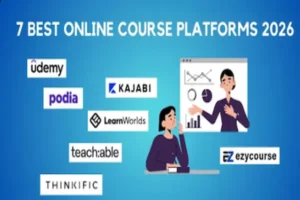
Kajabi is the undisputed industry leader for high-end creators in 2026. Its AI Creator Hub can generate full course outlines, marketing copy, and sales email sequences from a single prompt — a level of automation that used to require a dedicated marketing team. The trade-off is price: Kajabi sits at the premium end of the market, starting at around $149/month, but it genuinely replaces the need for separate email, website, and funnel tools.
Thinkific is the strongest option for creators focused on long-term scalability. Its zero-transaction-fee model means you keep 100% of what you earn regardless of volume — a critical advantage once sales start moving at scale. Its 2026 update introduced Thinkific Communities, allowing creators to build social networks directly around their learning content and increase student retention significantly.
Podia rounds out the all-in-one tier as the most beginner-friendly option available. Its clean interface and ability to sell digital downloads, webinars, and coaching sessions alongside courses make it the go-to starting point for creators who want everything in one place without a steep learning curve — and its pricing starts at just $39/month.
Best Course Creation Platforms for Community and Student Engagement
Some of the best course creation software in 2026 is built around the principle that community retention matters as much as content quality — and these platforms prove it.
Mighty Networks leads the community-first category and is particularly well-suited for creators who want their audience to engage with each other, not just consume content passively. Its Mighty Co-Host AI automates member icebreakers and content moderation, reducing the manual effort required to keep a community active and welcoming. This is the platform to choose if your long-term vision involves a high-engagement membership model.
Teachable remains one of the most trusted names in the US creator economy, largely because of its checkout experience. Its Teachable Pay system handles global tax compliance — including EU VAT — and automates affiliate payouts, which eliminates one of the most time-consuming administrative headaches that course sellers face when scaling internationally.
Circle is the fastest-rising contender in this space, merging professional community infrastructure with a polished course player. Creators who want their program to feel like a high-end private membership — rather than just another video library — consistently choose Circle for the premium experience it creates for students.
Creators who are exploring how platform-based education can accelerate a career pivot should also review structured vocational training programs — understanding how credentialed education works can strengthen the positioning of your own course offering.
Platform Comparison: What Each Tool Does Best in 2026
Before committing to any subscription, a side-by-side comparison helps clarify which platform actually matches your specific situation.
| Platform | Best For | Key 2026 Feature | Starting Price |
|---|---|---|---|
| Kajabi | Full business automation | AI Content Funnels | $149/month |
| Thinkific | Growing businesses | Zero transaction fees + Communities | $49/month |
| Teachable | Ease of selling | Advanced global tax handling | $39/month |
| Mighty Networks | Community-led growth | Mighty Co-Host AI | $41/month |
| Podia | Beginners and simplicity | Unlimited everything model | $39/month |
| Circle | Premium experience | Community + course player hybrid | $49/month |
The 2026 Trends Every Course Creator Needs to Understand
The online course creation platforms leading in 2026 are being shaped by three trends that directly affect what students expect — and what creators need to deliver.
The most transformative shift is AI-generated curriculum. The ability to upload a PDF or an existing video and have the platform automatically generate quizzes, lesson summaries, and structured descriptions has moved from a premium feature to a baseline expectation on competitive platforms. This alone has compressed the time required to launch a new course from weeks to days.
Equally important is the rise of the “anti-course” movement. US learners in 2026 are willing to pay significantly more for cohort-based courses and live community access than for evergreen video libraries — because they want access to the creator, not just the content. Platforms that enable live workshops, group coaching, and real-time interaction are capturing this demand effectively.
Finally, mobile-first delivery is no longer optional. With over 65% of US course content now consumed on mobile devices, platforms without a high-quality native iOS and Android app are actively losing market share to competitors who have prioritized the mobile experience.
How to Choose the Right Platform for Your Stage and Goals
The best platform for you is the one that matches where you are right now — not the one with the most features on paper.
- Just starting out? Podia or Teachable Basic give you everything you need to launch and sell without overcomplicating your setup or your budget.
- Ready to scale? Thinkific Pro eliminates transaction fees and adds the community layer that drives long-term retention — a powerful combination for established creators.
- Building a membership brand? Mighty Networks and Circle are built for exactly this model, with community tools that no traditional LMS can match.
- Want to automate your entire business? Kajabi’s AI tools and all-in-one stack justify the premium price for creators who are already generating consistent revenue and want to operate leaner.
One practical step before committing: most platforms offer a free trial of 14 to 30 days. Use that window to upload one real module, run through the student experience on mobile, and test the checkout flow — those three actions will tell you more than any feature comparison list.
If you are building a course as part of a larger professional development strategy, pairing it with recognized online certification programs can add credibility to your personal brand and strengthen your positioning as an authority in your niche.
What Free Course Creation Platforms Actually Offer
Free course creation platforms exist, but they come with trade-offs that are worth understanding clearly before you rely on them for a serious launch.
Most free tiers — available on platforms like Teachable, Thinkific, and Podia — allow you to publish a limited number of courses or students but charge transaction fees on every sale, sometimes as high as 10%. At low volume that feels manageable; at scale, it becomes a significant cost that a paid plan would have eliminated entirely.
The most genuinely free option for getting started is using a platform’s trial period to validate your idea before any financial commitment. Launch to a small audience, collect real feedback, and use that data to choose the paid plan that fits your validated model — rather than guessing upfront.
Creators who are also exploring how to fund their own continuing education alongside building a course business should look into career advancement programs that can support professional development costs through employer reimbursement or workforce funding.
This content is purely informational and independent. We have no affiliation, partnership, or commercial relationship with any platform, company, or service mentioned in this article. Always verify current pricing and features directly on each provider’s official website.
There is a lot more to explore when it comes to building skills, launching online income, and making smarter career moves. Head over to our Career Opportunities section for guides on training programs, certifications, and strategies designed to help you move forward with clarity.